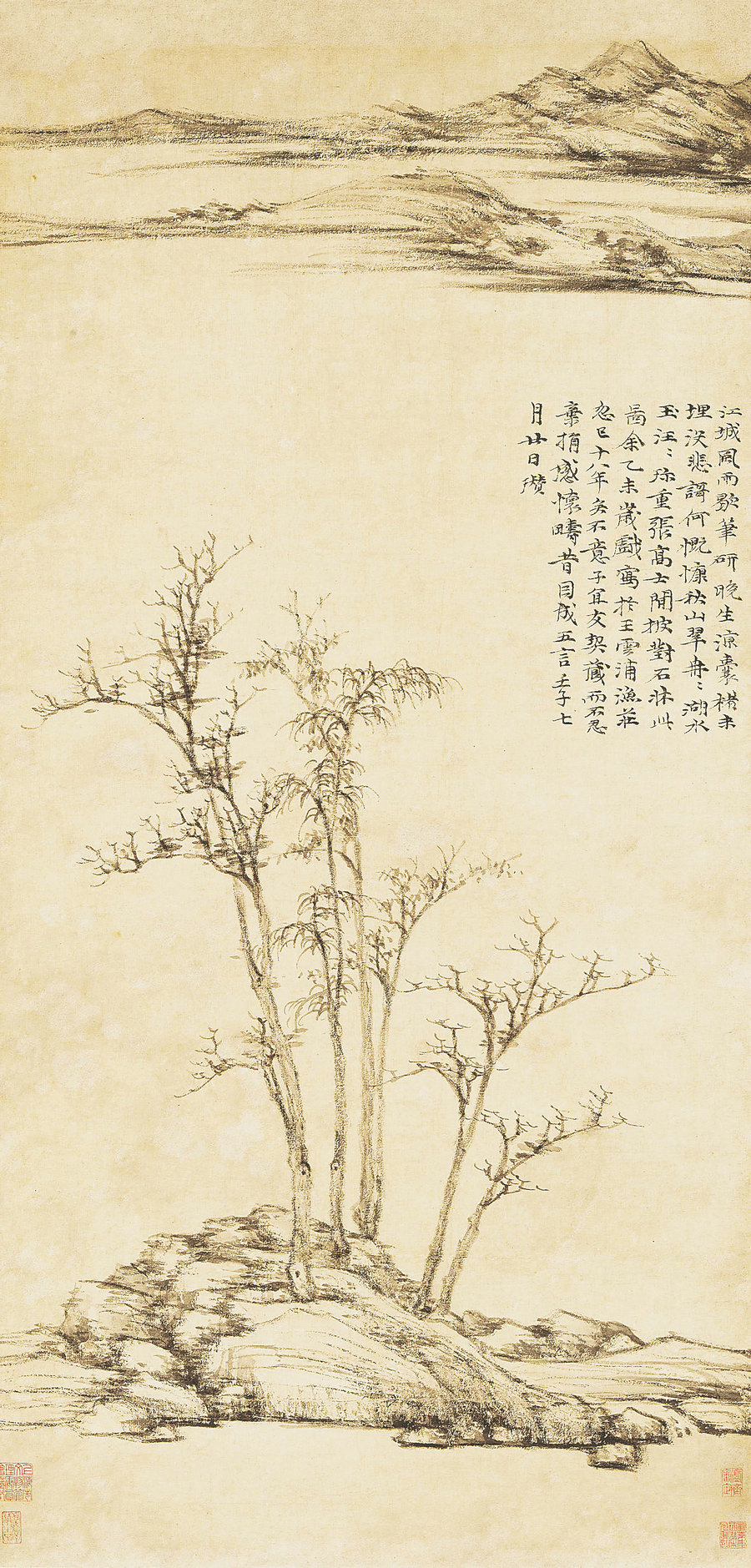
Ni Zan
Introduction
Ni Zan (1301-1371) was a distinguished Chinese painter and poet. Born in Wuxi, Jiangsu province, Ni Zan came from a wealthy and scholarly family that enabled him to receive a classical education, which deeply influenced both his poetry and painting. His works are celebrated for their minimalist compositions and are characterized by light ink, sparse landscapes, and a sense of detachment that reflects his reclusive and introspective nature. Ni Zan's artistic style set a precedent for future generations and left a lasting impact on Chinese art history.
Early Life
Ni Zan was born into a prosperous family in Wuxi, Jiangsu province, during the Yuan Dynasty. His father was a successful landowner and a patron of the arts, which provided Ni with the opportunity to immerse himself in scholarly pursuits from an early age. Receiving a comprehensive education in literature, philosophy, and the arts, he grew up surrounded by the literati culture that shaped his intellectual and artistic development. Despite the wealth and privilege of his early years, Ni Zan’s life underwent significant changes due to the political and social unrest of the time. As the Yuan Dynasty faced economic challenges and social upheaval, his family experienced a decline in fortunes, prompting Ni Zan to withdraw from societal affairs and pursue a more reclusive lifestyle.
Artistic Career
Ni Zan's artistic career is marked by his distinct approach to landscape painting, which emphasized simplicity, restraint, and an introspective understanding of nature. His works are often characterized by a minimalist style with sparse compositions, featuring scenes of rivers, mountains, and trees rendered in light ink washes. These elements conveyed a sense of tranquility and solitude reflecting his personal philosophy and response to the turbulent times he lived in.
Influences
Ni Zan was influenced by the literati culture of his time, which emphasized personal expression and the integration of poetry, calligraphy, and painting. The political instability and economic challenges of the Yuan Dynasty also shaped his worldview, prompting him to seek solace in nature and art. His style was influenced by earlier masters such as Dong Yuan and Juran, yet he developed a unique approach that prioritized spiritual expression over realistic representation.
Style and Technique
Ni Zan’s style is distinguished by its purity and simplicity. He employed a restrained palette, often using only ink and light colors, to create compositions that conveyed a profound sense of serenity and detachment. His technique involved the use of delicate brushstrokes and empty spaces, or liubai, to evoke the natural landscape without overwhelming detail. This minimalist approach allowed viewers to engage with the emotional and philosophical depths of his work, emphasizing the spiritual over the physical.
Major Works
Among Ni Zan's notable works are his ink paintings on paper that reflect his distinctive style and philosophical introspection. Some of his well-known pieces include Rongxi Studio, Six Gentlemen, and Wind in the Pines Among a Myriad Valleys. These paintings exemplify his mastery of ink wash techniques and his ability to create evocative landscapes with minimalistic detail. His works often feature simple compositions with a few trees, mountains, and bodies of water, leaving large areas of the paper untouched, which became a hallmark of his style.
Legacy and Influence
Ni Zan's approach to painting had a profound impact on the development of Chinese art, particularly influencing later generations of literati painters. His emphasis on simplicity, personal expression, and the integration of poetry and painting became central tenets of the literati aesthetic. His work inspired subsequent artists, such as Dong Qichang during the Ming Dynasty (1368-1644), who further developed the literati style. Ni Zan’s legacy continues to be celebrated for its contribution to the evolution of Chinese landscape painting, embodying the ideal of art as a medium for personal reflection and spiritual exploration.
Ni Zan's Place in Chinese Art History
Ni Zan holds a pivotal place in Chinese art history as one of the foremost figures of Yuan Dynasty painting. His minimalist landscapes and philosophical approach to art marked a departure from the more detailed and decorative styles that preceded him. By emphasizing personal expression and the emotional resonance of the natural world, Ni Zan forged a path that would influence centuries of Chinese painters. His work represents a critical moment in the transition toward the literati painting tradition, valuing the artist's inner vision and the poetic interplay between image and emotion. His influence is seen not only in the works of his contemporaries but also in the broader trajectory of Chinese art, where his ideals of simplicity and introspection continue to resonate.
In conclusion, Ni Zan's contributions to Chinese art are profound and enduring. His unique approach to landscape painting, characterized by minimalist compositions and a focus on spiritual depth, has left a lasting legacy that continues to inspire artists and art enthusiasts alike. His work represents a significant chapter in the history of Chinese art, embodying the values of personal expression and the harmonious integration of art forms that define the literati tradition.








